Danish Humair
Software engineer · MS Computer Science at UT Dallas, graduating May 2027
I build software end to end: mobile and web clients, the backends behind them, and more and more often the ML that makes them useful. This summer I was one of two engineers who took Anything Piano from pre-beta to its public iOS launch at Play Anything. Before that, I built Clinpax's real-time AI medical scribe on my own; GPs in Australia, Saudi Arabia and Pakistan now use it in their consultations.
I've also done research along the way, including a co-first-author paper at ECML-PKDD on diffusion-based image compression, and I'm currently writing a thesis on LLM-driven CAD generation. I'm looking for full-time software engineering roles starting in 2027.
Experience
May – Aug 2026 Engineering Intern, Play Anything (formerly Songscription) One of two engineers taking Anything Piano, a music-learning app, from pre-beta to public iOS launch.
- Owned major areas of the app on a three-person core product team, working directly with the CTO and CPO.
- Closed 115 product tickets and merged 80+ PRs in 9 weeks: practice scoring, MIDI and audio playback, piano-roll interactions, native Swift/Metal rendering and performance work, onboarding, and search and library flows.
- Built features across the whole stack: the React Native client, the Supabase/PostgreSQL backend, and the native iOS layer, including learning and scoring systems, content workflows, and backend scheduling and batching for re-engagement notifications.
- Turned high-level product direction into shipped features, and proposed product concepts that were adopted into the roadmap.
React Native · TypeScript · Expo · Swift/Metal · Supabase · PostgreSQL · San Francisco Bay Area
Apr – Jul 2025 Founding Engineer, Clinpax Designed and built a real-time AI medical scribe on my own; it's in clinical use by GPs in three countries.
- Sole engineer: designed, built and shipped the scribe from scratch. It's used in real consultations in Australia, Saudi Arabia and Pakistan, and the current team continues to build on this architecture.
- Built a multi-agent system that generates clinical insights under healthcare safety constraints.
- Built an evaluation framework with GP annotations across 50+ consultations to benchmark and refine those insights.
- Developed a low-latency real-time transcription and diarization pipeline, benchmarked for accuracy and latency against alternatives.
Next.js · FastAPI · Azure · AWS · OpenAI APIs · Melbourne (remote)
Dec 2023 – May 2025 Software Engineer, then Project Lead, AI for Healthcare Initiative, LUMS Built an Android app for migraine patients that feeds ML-based onset prediction, then led the team behind it.
- Built a native Android app from the ground up for patients to log migraine episodes and triggers, supporting ML-based onset prediction from passive sensor streams. Reached 100+ early sign-ups.
- Designed the interface through iterative testing and in-person focus groups with patients, so it stays usable during an attack. It also had to work on older phones and unreliable connections.
- Built a dashboard for doctors to follow their patients, and maintained both through bug fixes, feature updates and CI/CD.
- Promoted to project lead in January 2025: led a 15-member cross-functional team, assigning work, mentoring members, and keeping execution aligned with the research goals.
Android · Firebase Realtime Database · Figma · Adobe XD · Lahore
Research & teaching
Feb 2026 – now Graduate Researcher, Design & Engineering for Making Lab, UT Dallas M.S. thesis with Dr. Liang He: an automated, LLM-driven pipeline for generating CAD models of mechanical parts.
- Thesis: an automated pipeline that uses LLMs to generate CAD for mechanical parts.
- Before that, built a camera-based 3D spatial reconstruction pipeline (ArUco markers, OpenCV) to enable autonomous object grasping for an assistive robotic wearable.
May 2024 – Jul 2025 Research Assistant, Internet, Data and Society Lab, LUMS Diffusion models for extreme image compression on the web, with Dr. Ihsan Ayyub Qazi and Dr. Zafar Ayyub Qazi.
- Added colour information through a custom-trained ControlNet, improving image similarity by 22.9% while keeping the bandwidth savings.
- Automated detection of salient features (faces, logos, text) with GPT-4 Vision and Grounded SAM, scaling experiments 30× across a stratified dataset drawn from the top 1,000 websites.
- Designed a GPT-4 Vision process to classify the CrUX top 1,000 websites for dataset curation, reaching 90% agreement with human ratings.
- Ran an in-person user study with 30 participants. Wrote the image-generation pipeline, experiments and evaluation; wrote the methodology and user-study sections and made all the figures.
- Managed and mentored three lab interns.
Jun – Dec 2024 Teaching Assistant, CS 6303: Topics in Large Language Models, LUMS Full-time TA for the first offering of a graduate, research-project-based course.
- Advised and oversaw research projects for 48 undergraduate and graduate students.
- Designed and graded programming assignments, quizzes and paper-review homework, and held bi-weekly office hours.
- Built small data-entry tools for attendance and class-participation tracking.
Publications
- Quality-Preserving Extreme Image Compression: Using Interpretable Conditioning Inputs with Diffusion Models
- Rethinking Image Compression on the Web with Generative AI
- Evaluating the Feasibility of Using Generative Models to Generate Chest X-Ray Data
* equal contribution
Projects
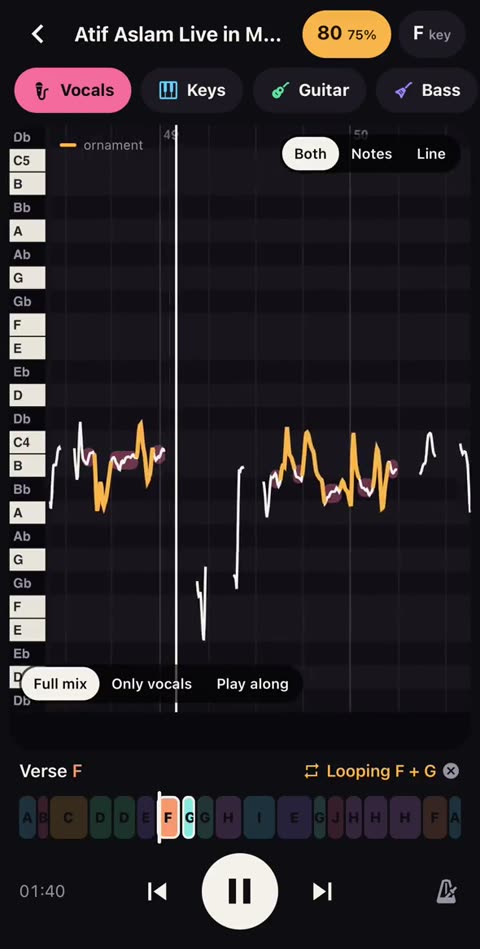
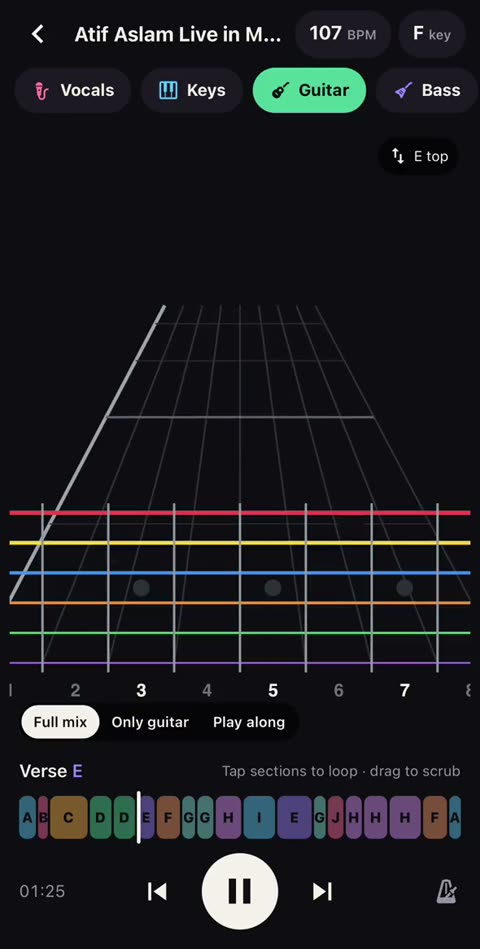
2026 Moseekhi · web and iOS A music-practice app. Add a song; it gets split into parts and transcribed, and you practise each part in a view that suits the instrument.
The name joins moseeqi (music) and seekhna (to learn). Every song gets separate stems, beats and sections, key and chords, vocal pitch, note transcriptions and word-by-word lyrics, and all the views (vocal pitch contour, 3D piano, guitar and bass highway, chords, lyrics) run on one shared clock. Loop, tempo, key and metronome controls apply to every view at once, and transposing the audio also transposes the notes and chords on screen.
- Processing: a Python pipeline on Modal GPUs that runs 6-stem source separation, beat and downbeat tracking, bar-aligned section detection, key and chord estimation, vocal pitch tracking, note transcription, and Whisper lyrics with syllable alignment. It costs about 4¢ per song.
- Web app: Next.js and React, with Canvas 2D and three.js views, plus Supabase for auth, storage and a credit system. Failed jobs are refunded automatically.
- iOS app: Expo and React Native with a native Swift audio engine. All stems start on the same host-time tick, so they stay sample-aligned through tempo and key changes and gapless multi-section loops.
- Evaluating models: alternative model outputs are computed alongside the current ones and shown as a blind A/B comparison, so I can tell which one actually sounds and reads better.
TypeScript · Next.js · React Native · Swift · Python · PyTorch · FastAPI · Modal · Supabase · moseekhi.app
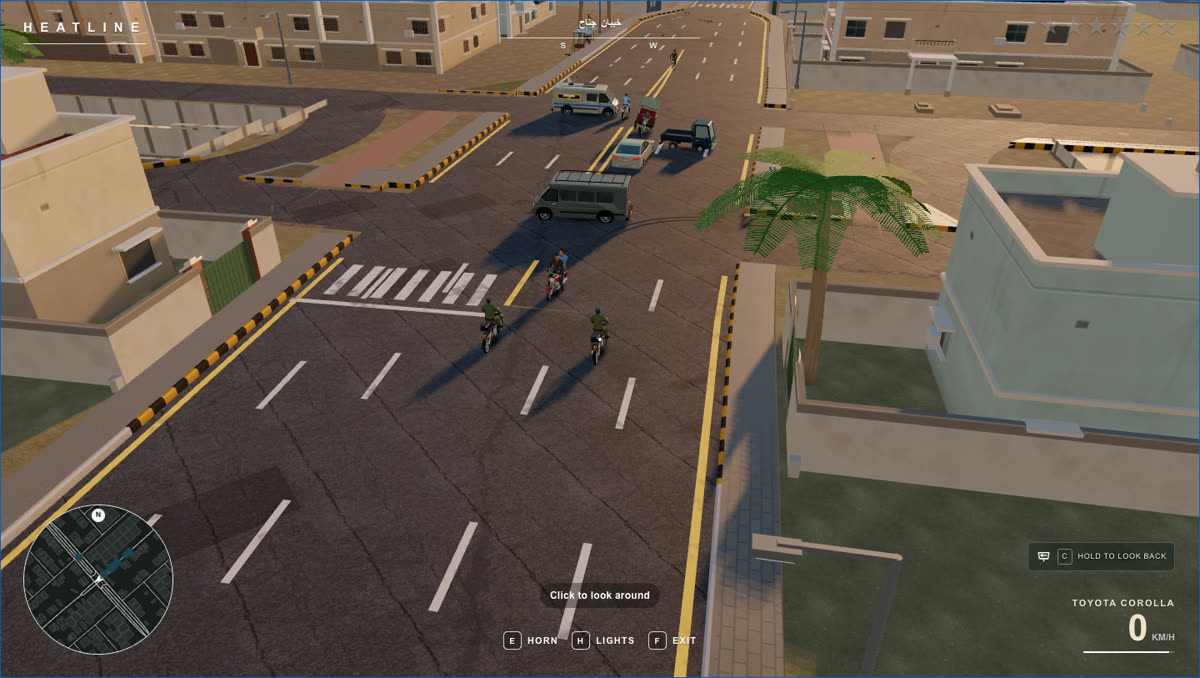
2026 Karachi: Heatline · browser game An open-world driving game in the browser, built on real OpenStreetMap data. Its test bed is Lahore, starting at the LUMS campus.
A side project I've been building since July. I want the city to run as a system rather than as scripted set pieces: traffic follows a real road graph, pedestrians keep persistent identities, and the police response escalates.
- World: OpenStreetMap tiles are turned on demand into roads, junctions, sidewalks and buildings, and streamed into a Three.js scene. The routing graph respects direction and layer, so a bridge is never treated as a crossing just because two lines overlap on the map.
- Traffic: AI drivers with different personalities, right-of-way rules and deadlock handling, plus vehicle handling with tyre slip and skid marks.
- Police: a pursuit state machine with escalating wanted levels, intercepts, and air support.
- People: pedestrians keep identities and voices across their lifetime. Dialogue is a romanized-Urdu corpus voiced by twelve generated voices, assigned deterministically so the same person always sounds the same.
TypeScript · Three.js · React · Next.js · Supabase · OpenStreetMap · play in the browser
2026 PivotHCI A non-linear way to chat with an LLM. In a user evaluation, people reported more control than with linear chat.
I designed and evaluated a new, non-linear interaction paradigm for LLM chat. In the user evaluation, participants reported higher perceived control than with a standard linear chat.
2023 – 2024 Journaly.io · co-founder A privacy-focused, highly customizable mood tracker built in React Native.
- Co-founded and developed the app, designing the interface with target users so it stays customizable without getting complicated.
- No usable drag-and-sort library existed for what we needed, so I wrote a high-performance one for React Native.
- Set up CI/CD to TestFlight and Google Play for quick beta iterations.
React Native · C# · PostgreSQL
2023 LLM4LLU A voice-to-voice WhatsApp bot that gives low-literacy users access to LLMs. It reached 500+ users within 72 hours.
Built on whatsapp-gpt, an open-source WhatsApp bot I'd written earlier. Users can speak instead of typing and hear replies instead of reading them. Once I made it public, it spread by word of mouth to 500+ users within three days. We then studied it in a Generative AI course project, looking at how it helps with tasks like finding information on the web or filling out government forms.
2022 Zambeel+ and Portal2LUMS · Chrome extensions Browser extensions for LUMS students, picked up by 100+ students within 30 days by word of mouth.
- Zambeel+ adds crowd-sourced grade statistics, clash detection while enrolling, one-click resource downloads and a dark mode to the university's portal.
- Portal2LUMS opens any tab through the campus VPN in one click, replacing a tedious manual process.
ongoing Open source Features and fixes for Seerr (formerly Jellyseerr), Submitty, yt-dlp and others.
My contributions have covered authentication, API integrations, backend logic, media tooling and application bugs. They include community-requested features and fixes for Jellyseerr (now Seerr), a widely used media request manager, and a fix for a Submitty bug that stopped students from submitting assignments. In 2024 I also designed and built the new website for the Center for Speech and Language Technologies at LUMS.
Education
Tools I use
- Languages
- Python, TypeScript/JavaScript, Swift, C++, Kotlin, Java, Go, SQL, C, C#
- Product
- React, React Native, Expo, Next.js, Node.js, FastAPI, SwiftUI, Jetpack Compose
- ML
- PyTorch, TensorFlow, Hugging Face, scikit-learn, OpenCV
- Infrastructure
- PostgreSQL, Supabase, Firebase, AWS, Azure, Vercel, Docker, GitHub Actions
- Design
- Figma, Adobe Creative Suite, 3D modelling
Outside of work
I'm a self-taught pianist and also play guitar, drums and bass. At LUMS I was Assistant Director of the Music Society, and I produce and mix music. That probably explains why I keep ending up building music software.